
Not legal advice. This page sorts public sources, as of 3 Nov 2026. Figures and quotes come from the linked sources. Forecasts are statements by the people named, not facts.
In short
- The AI Act, the EU regulation on artificial intelligence (Regulation (EU) 2024/1689), has been in force since 1 Aug 2024 and applies in stages. Most rules have applied since 2 Aug 2026.
- The AI Omnibus (Regulation (EU) 2026/1744, in force since 27 Jul 2026) moves the high-risk rules: Annex III from 2 Dec 2027, Annex I from 2 Aug 2028.
- The AI Act does not yet apply in Liechtenstein. It first has to be taken into the EEA Agreement. The government expects entry into force in the course of 2027. That is a plan, not law.
- If you offer AI systems in the EU or have AI output used there, the AI Act can already apply to you, even with a seat in Liechtenstein.
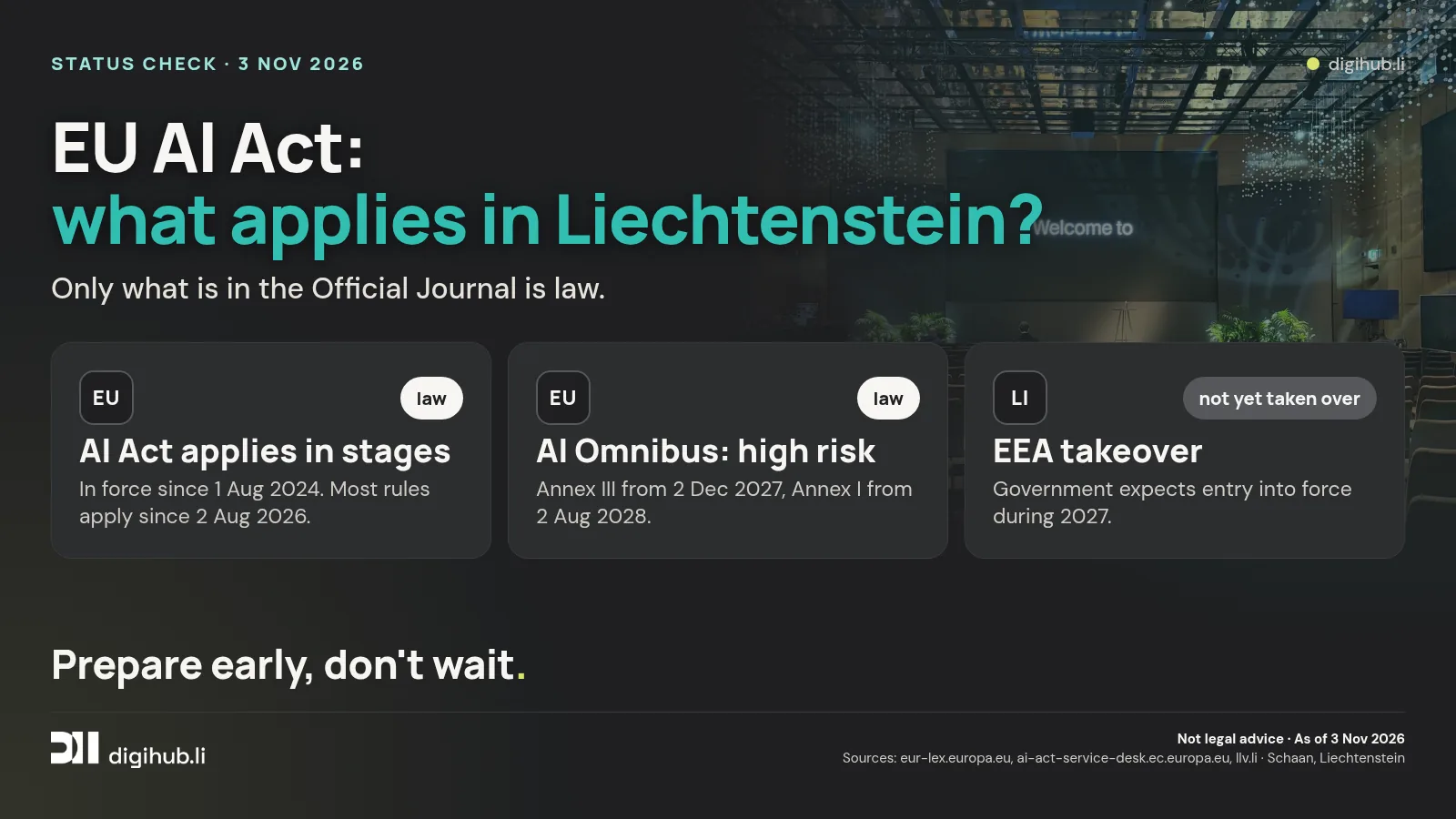
Status check 3 Nov 2026
What applies, what is coming?
Sorted briefly, with primary sources. Only what is in the Official Journal is law.
EUlaw
AI Act applies in stages
- In force since 1 Aug 2024.
- Prohibitions and AI literacy since 2 Feb 2025, rules for GPAI models since 2 Aug 2025.
- Most rules since 2 Aug 2026, including transparency obligations under Art. 50 (AI Act Service Desk).
EUlaw
AI Omnibus: new deadlines
- In force since 27 Jul 2026.
- High-risk AI under Annex III from 2 Dec 2027, under Annex I (products) from 2 Aug 2028.
- SME relief now also covers small mid-caps (European Commission).
LInot yet taken over
EEA takeover under way
- According to the government the AI Act is in the EEA incorporation procedure (BuA 59/2026).
- Under current planning, entry into force is expected in the course of 2027.
- An implementing act is needed, a sandbox is being set up.
As of 3 Nov 2026. We update this page when things change.
Timeline: what applies when
The dates apply in the EU. For Liechtenstein they count only after the takeover into the EEA Agreement, unless a business is active directly in the EU market.
| Date | What applies | Status |
|---|---|---|
| 1 Aug 2024 | AI Act enters into force | law |
| 2 Feb 2025 | General provisions (definitions, AI literacy) and prohibitions | applies |
| 2 Aug 2025 | Obligations for providers of GPAI models, EU-level governance, national authorities and penalty rules | applies |
| 2 Aug 2026 | Most rules, transparency obligations (Art. 50), enforcement starts | applies |
| 2 Dec 2026 | New prohibitions for AI generating non-consensual sexual deepfakes or child sexual abuse material. Transition deadline under Art. 50(2) for certain systems already on the market before 2 Aug 2026 | law, from date |
| 2 Aug 2027 | At least one AI regulatory sandbox per EU member state | law, from date |
| 2 Dec 2027 | Rules for high-risk AI under Annex III (after the AI Omnibus) | law, from date |
| 2 Aug 2028 | Rules for high-risk AI in products under Annex I (after the AI Omnibus) | law, from date |
| during 2027 | Entry into force in Liechtenstein via the EEA Agreement | government plan |
Sources: AI Act Service Desk, timeline, EUR-Lex 2024/1689, EUR-Lex 2026/1744, BuA 59/2026.
The four risk levels
The AI Act does not regulate "AI" as a whole, but applications by their risk (European Commission: regulatory framework for AI).
| Level | Examples | What applies |
|---|---|---|
| unacceptable | Social scoring, harmful manipulation, emotion recognition at work and in schools, untargeted scraping of facial images | Prohibited (Art. 5), since 2 Feb 2025 |
| high | AI in recruitment, education, credit scoring, critical infrastructure (Annex III) or in regulated products (Annex I) | Risk management, data quality, documentation, human oversight; from 2 Dec 2027 and 2 Aug 2028 |
| transparency | Chatbots, AI-generated content, deepfakes | Disclose that people are talking to AI; label content (Art. 50), since 2 Aug 2026 |
| minimal | For example spam filters or AI in video games | No additional obligations under the AI Act |
What does this mean for SMEs?
- AI literacy: Since 2 Feb 2025, providers and deployers of AI systems in the EU should ensure sufficient AI literacy of their staff (Art. 4). The AI Omnibus simplified this obligation; the Commission and member states take a stronger role.
- Transparency: If you use a chatbot or publish AI content, you must disclose or label it in the EU since 2 Aug 2026 (Art. 50).
- Check for high risk: Using AI to screen job applications, for example, falls under employment, i.e. Annex III. These obligations apply in the EU from 2 Dec 2027.
- Relief: For fines, SMEs get the lower of the two amounts (Art. 99). The AI Omnibus extends SME relief to small mid-caps and widens access to sandboxes.
- Fines: up to €35m or 7% of worldwide annual turnover for prohibited practices, up to €15m or 3% for other obligations, up to €7.5m or 1% for incorrect information (Art. 99).
Practical tip (not a legal obligation, but how we work): list which AI tools you use for what, who operates them and where results reach clients or applicants. That's the basis for any further check.
Status in Liechtenstein
- EEA takeover: The EFTA EEA-Lex register lists the AI Act as "under scrutiny". There is no EEA Joint Committee decision yet (EFTA EEA-Lex, as of 3 Nov 2026).
- Government: "Under current planning, entry into force is expected in the course of 2027" (our translation). The exact date depends on the EEA takeover (BuA 59/2026, 12 May 2026, German).
- Implementation: According to an interview on digital-liechtenstein.li an implementing act is needed and a sandbox is being set up. Judith Sild: "We hope the takeover process can be completed in the course of next year" (our translation; digital-liechtenstein.li, 27 Jul 2026, German).
- Relevant today: According to the same interview, the market location principle applies. If you are active with AI in the EU market, you already have to follow the EU rules there.
- Other frameworks: The national administration has its own AI strategy (AI strategy of the national administration, version 1.0, German). Liechtenstein has signed the Council of Europe Framework Convention on AI (Council of Europe).
From practice: go-lives and cases
What we build ourselves with AI. Client names only where the client published them; cases stay anonymised.
digihub · In der Specki 3, Schaan
AI in your own business: where do we start?
We don't start with a tool, we start with a bottleneck: which workflow eats noticeable time today? Then we build a pilot with real examples from your daily work and bring it into operation (The Automation Layer). The first conversation takes 30 minutes and is non-binding.
Prefer to work on site? At digihub in Schaan there's coworking with a Flex Desk from CHF 169, a Full Desk from CHF 299 or a Private Office from CHF 549 a month, plus meeting room and community.
Read next
Sources
- Regulation (EU) 2024/1689 (AI Act), EUR-Lex
- Regulation (EU) 2026/1744 (AI Omnibus), EUR-Lex
- AI Act Service Desk: implementation timeline
- European Commission: AI Omnibus enters into force, 27 Jul 2026
- European Commission: regulatory framework for AI
- EFTA EEA-Lex: 32024R1689
- Government report BuA 59/2026, 12 May 2026 (German)
- digital-liechtenstein.li: Der AI Act ist gestaffelt anwendbar, 27 Jul 2026 (German)
- regierung.li: AI strategy of the national administration (German)
- Council of Europe: Liechtenstein signs the AI treaty
Not legal advice. Whether and how a rule applies to your business is a question for a qualified adviser. As of 3 Nov 2026.
Content from digihub.li · reviewed 3 November 2026.